Saturday, 28 June 2008

Melilla - Spanish Enclave

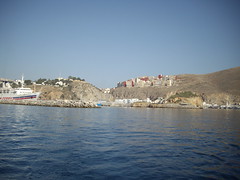
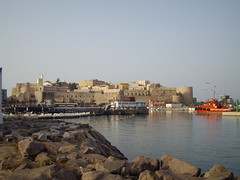
Fort at Melilla


WEDNESDAY 25 - FRIDAY 27 JUNE 2008

The morning after we arrived a brass band started up when a very large Spanish naval vessel arrived - Melilla is Spain’s largest naval base and the town has been in the hands of the Spanish since 1497.

David on the boat next door, who suffers from diabetes, had had a stroke and the ambulance and fire brigade had quite a problem getting him out as he was stuck at the chart table. As they lifted him out he clung to his boat, not wanting to let go. It’s frightening how quickly these things can happen. He was talking to us in the morning and by lunch time he was critically ill in hospital.

It was very hot – about 40 degrees and 31 degrees in the boat! It seems we have found the Mediterranean heat at last, although Roger is saying it’s too hot! We rigged the wind scoops over the hatches which worked for the forward hatch but because of the bimini over the cockpit there isn’t a flow of air to the aft hatch. It was my turn to suffer from Moroccan tummy, but it only lasted a couple of days.

Melilla has quite a good shopping centre near the old fort and a lovely long beach. The mix of people is interesting, as about 40% of the population is Moroccan.

The Marina is excellent with several tapas bars and cafes and very helpful staff – the only down side is that the bars seem to turn into night clubs and go on until 6 a.m.! However, at 8 euros a night, Melilla has got to be one of the cheapest moorings in the Western Med, so we are seriously considering putting the boat here for the winter. One of the disadvantages would be the extra journey by plane or ferry from Malaga.

Thursday, 26 June 2008

Al Hoceima to Melilla - 60 Miles

Leaving Al-Hoceima


TUESDAY 24 JUNE 2008

We decided to leave early because we had a long sail ahead of us and went to check out with the police, together with the French couple. We had to wait until 8.30 a.m. when the police came on duty and we had to wait ages for them to deal with the passports. We said we wanted to anchor in Ras Baraket, a small bay and were told this would be Ok. We then had to wait for the customs men to arrive – four of them arrived in a car and the police took a photo of our boat. We told them that we wanted to anchor in Ras Baraket and they said it would not be permitted as the area is heavily patrolled because of drugs and immigration. We told the police we hadn’t paid the port fees, and they said if no one came to ask for it, not to worry. All the police and customs were very friendly but it seemed to take a long time to check out. We finally left about 9.15 a.m.

There was quite a swell when we left until we rounded Cabo Quilates and then the sea was completely flat with no wind. We spotted dolphins about 3 times but they weren’t very interested in us. The autohelm stopped working completely and we had to hand steer the whole way. We had to transfer diesel at sea – not the best transfer we’ve ever done as one of the cans fell on its side when the boat rolled.

We arrived in Melilla about 8.30 p.m. Moroccan time, 9.30 p.m. Spanish time and the phones went on to Spanish networks. Melilla is another Spanish enclave on the Moroccan coast. We picked up the Mediterranean mooring with the help of the Marinero and the people on the next boat, who are from Britain and have been here for four years!


Marina: 8 Euros a night including electricity, water, good showers and free wi-fi (albeit slow). The cheapest Marina yet.

Cala Iris to Al-Hoceima - 25 MIles

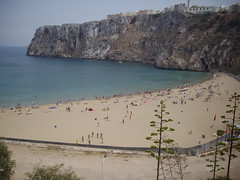
Beach at Al-Hoceima


MONDAY 23 JUNE 2008

It was a misty start to the day, so we put the radar up. After telling the police we were leaving, we sailed past Penon de Velez where there is a rock still in possession of the Spanish which the Moroccans would like back. We spotted dolphins, but they didn’t come and play with the boat.

We motor-sailed the whole way and the wind got up and the sun came out just as we arrived. We berthed on the quay opposite the ferry terminal, which is covered in guano. There was one another visiting boat there belonging to a French couple who have a flat in Lagos. A policeman and policewoman came on board and looked in a lot of the lockers on the boat.

When all the formalities were over we walked up the steep hill to the town and had lunch in a restaurant overlooking the beautiful bay. I bought a leather belt hand made by the Berbers from a very friendly shopkeeper, and because we said ‘Thank You’ in Arabic ('Shukran') he taught us to say ‘Thank You’ in Berber.

El-Jebha to Cala Iris - 17 Miles

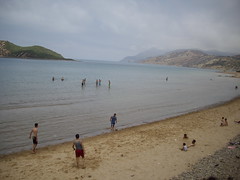
Cala Iris Bay


SUNDAY 22 JUNE 2008

Barbara and Tudor left for Malaga and we set off for Cala Iris. Roger realized his fishing hand line had been stolen from the boat. We were quite surprised as the Harbour Master had told us there was no crime here, and people could leave their doors open. However, we thought they probably needed it more than we did, and we can easily get another one.  

We had a flat sea all the way and the oil pressure seemed to settle on the red. We think that when it had it’s spasm it shook it lower down the scale. When the engine is off the needle is as far down as it can go, instead of the usual position of ‘0’.

We arrived at Cala Iris, a fairly new fishing port, which is about 3 miles East of where the Pilot Book says  it is. A friendly policeman came on board as soon as we arrived with the usual detailed questioning, including how many children we had! He told us they only get about one boat a month coming here, mostly from Spain. This is probably because the Pilot Book is rather vague about facilities for yachts.

Cala Iris makes El-Jebha look like a Metropolis! There are Port Authority and Police buildings, the Co-operative Fishery, fishermen’s cottages and a few basic eating houses.

We went to the beach which was quite busy with Moroccans, but once again not many women. In the evening we went to one of the eating houses and had grilled sardines and chips which cost £5 for two, including drinks.
Barbara and Tudor leaving El-Jebha


El-Jebha, Morroco

El -Jebha
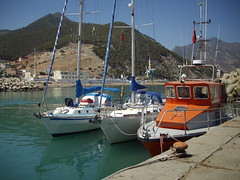
Susannah and Yooannmee moored together
SATURDAY 21 JUNE 2008

Roger and Tudor played with their SSB radios trying to get weather information from the Monaco station. Our SSB radio is not picking up the broadcasts so Roger fitted an earth to it. He also changed the oil and oil filter (in his best fawn coloured shorts) to see if it made any difference to the oil pressure gauge (it didn’t). Barbara and I went to walk around the town which was surprisingly busy with small cafes (always filled by men, not women), small shops selling a variety of goods and stalls on the road selling jeans, figs and plums. We bought some of the lovely Moroccan bread and fruit. All the people seem really friendly and are happy showing you the way without expecting money.

It was very hot, so Barbara and I packed a picnic and Roger helped Barbara blow up the canoe. The friendly young harbour master came to chat to us and told us he had worked as a Fisherman for ten years, working for a few years on an Irish boat where he had learned English. He is hoping the area can be developed a little to encourage more visitors, particularly when they have such a beautiful spot with the Rif mountains overlooking the Mediterranean. He comes from Rabat, where his wife is living, and he goes back for a weekend once a month. The Fisheries boat had gone out into the bay with a Professor on board looking at the viability of starting a Fish Farm as fish stocks are dwindling in the area.

Barbara and I canoed about a mile across the bay to the beach and went for a swim. A group of very pretty little girls came and sat nearby. They seemed shy but wanted to talk to us and asked what we were called. Eventually they plucked up courage to ask if we had got a pen! I had brought two with me and gave them one and they seemed very happy. It seems the boys want sweets, whisky and cigarettes and the girls want pens! It’s nearly always boys who are out playing, and not long after a group of boys came and the girls went away. The children seem intrigued to see foreigners. Barbara lent one of them her snorkel and mask, but soon after the boys were chased away by a man who told them not to bother us.

Barbara and I canoed back to the boat and the boys jumping from the harbour entrance came over and wanted us to tow them. When there were about four on the canoe I couldn’t maneuver it but they let go when asked. We let them jump into the canoe when we got it back to the boat. The canoe is extremely stable as there were about six boys climbing in and out of it and it still did not capsize.

In our absence Roger had taken a walk into the town, hoping to get rid of the rubbish. A small boy followed him at 25 paces all the way into the town and back to the port!

For an out-of-the-way place, surprisingly El-Jebha has a few internet cafes. We took our own computers along as it is very difficult typing on the Arabic keyboards as a lot of the letters are in different places. My computer wouldn’t connect so I used their computer, but it was very, very slow.

There are small eating houses in El-Jebha but they all seemed to be full of men watching football. We eventually found a larger one with a terrace and had an excellent meal for the four of us for less than £20. We had coffee on Susannah and the Harbour Master came over to say goodbye. Barbara and Tudor have decided to cross to Malaga tomorrow as they are meeting up with friends who live in the Mar Menor.
Smir to El-Jebha, Morroco - 47 Miles

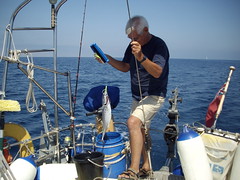
Roger's best catch ever!


FRIDAY 20 JUNE 2008

We left Smir about 8.30 with Tudor and Barbara after checking out with immigration. We motor-sailed and started the water maker. It didn’t work at first and Roger had to blow water through the outlet, as there was a blockage because it hasn’t been used since last September. It had been a cloudy start to the day but soon the sun came out and it was lovely and warm. We were able to sail from about 12 p.m. in a flat sea, but had to put the engine on to tack away from the land. The wind died so we motor-sailed the rest of the way. Roger fished again and had his best catch ever – a 20 inch bonito, large enough to feed 4! He gutted it and I marinated it ready for tonight. A pod of dolphins came to play with us for about half an hour, we saw a sun fish and a very large turtle. All this against the magnificent backdrop of the Rif Mountains.

It can’t all be plain sailing, and we had a couple of technical problems apart from the water maker. The oil pressure gauge starting vibrating back and forth very quickly and eventually vibrated near the low mark, although there was plenty of oil in the engine. Roger was worried it could be a blocked filter so we kept monitoring it. The autohelm started freezing every time we opened the water tap! We had to turn the autohelm off and back on to get it to work. The C-Map on our chart plotter was about ¾ mile out as we neared El-Jebha and showed us on land!

We moored in the small fishing harbour against the Fisheries boat. Two Immigration Officers came on board and took ages to complete the paperwork and wanted to know very detailed information, even what make our VHF was! I asked if we could take our boat round to the next bay for the day to swim, and back to El-Jebha for the evening. I was told this was not permitted. We could anchor in the bay but would not be able to come back. The area is very tightly controlled because of drugs and illegal immigrants. There are even manned sentry boxes on the hill looking out to sea. Kif is one of the main crops cultivated in this area.

Tudor and Barbara arrived about 7.30 p.m. and had had the same problem with their oil gauge! Very weird – it reminded us of the film Wolfcreek.

The four of us had an excellent meal on Susannah and all agreed the marinated tuna was the best we have ever tasted. The village boys kept asking for Bon bons and when we said we hadn’t got any, they asked for whisky and cigarettes!

El-Jebha Port Fees: Free, no facilities

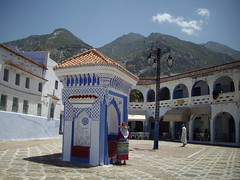
Chefchaouen

Chefchaouen with the Rif Mountains in the background


CHEFCHAOUEN

THURSDAY 19 JUNE 2008

We used the same taxi driver as yesterday and went to Chefchaouen, a Berber village in the Rif Mountains about 80 kilometers away, with Barbara and Tudor.  The taxi driver had to go to the police as he was going outside the 50 kilometer limit. The drive was spectacular with fantastic views of the mountains and isolated villages. We passed the end of a sheep market which had started at 6 a.m. and saw loaded mules and Berber men and women cutting wheat by hand. We also saw black kites and an owl sitting on a telegraph pole. We stopped at a road side stall and bought some fresh figs where the people, as we have found everywhere in Morocco, were very friendly.

Until the 1920s, only four Europeans had ever visited Chefchaouen. The buildings in the Medina are painted a lovely white and pale blue. We had a look at the small shops and met a shopkeeper from the village who is called Bruce and I told him I was called Sheila. His wife is Scottish. Barbara tried to reduce the price of a poof by suggesting the mark on it was because he had had a little accident! Luckily he saw the funny side. We had a very cheap lunch in a local cafĂ© – less than £10 for the four of us, and then visited the large Berber market as it is market day on Thursdays. The market is very colourful with the Berbers dressed in their different costumes according to their different tribes.